

Learn about its causes & symptoms below - and our efforts to eliminate trachoma and trichiasis - particularly in Ethiopia where there is the highest burden.

What Is Trachoma Disease and How Does It Cause Blindness?
Trachoma is an infectious eye disease and one of the leading causes of blindness globally. If left untreated it can develop into trichiasis - a painful condition where the eyelids turn inwards and the eyelashes rub against the surface of the eye leading to irreversible blindness.
Authored by Dr. Alemayehu Sisay M.D MPH
Dr. Alemayehu Sisay is Orbis Ethiopia Country Director and a Senior ophthalmologist. He is one of the leading trachoma experts globally and a strong advocate for comprehensive eye care to help improve lives and build equality around the world.

What Is Trachoma?
Trachoma is a highly contagious bacterial infection of the outer eye often experienced in childhood (aged 1-9). Trachoma also affects more women than men, as traditional gender roles mean that women are still more likely to have a larger share of domestic work and child rearing responsibilities.
The disease was eliminated in most industrialized nations by the 1950s, but is sadly still common in areas of the world where there is poor sanitation and lack of clean water. According to the Museum of Family History, trachoma was one of the main reasons immigrants were turned away from entering the United States at Ellis Island in the early parts of the 20th century.

1.9 million people
have been left visually impaired as a result of trachoma

450,000 people
have been left irreversibly blind because of trachoma

40% of children
between 1-9 years old have active trachoma in Ethiopia
What Is Trichiasis?
Trachoma can lead to trachomatous trichiasis in the later stages of the infection. Trachomatous trichiasis can occur when repeated infections off the inner part of the upper eyelid cause the upper eyelid to turn inwards so that eyelashes scrape on the eyeball - resulting in excruciating pain and permanent scarring of the front of the eye (the cornea). If left untreated trachomatous trichiasis will lead to blindness in most cases.
According the World Health Organization there are 2.5 million people living with trachomatous trichiasis.
Causes of Trachoma and Trichiasis
Bacterium known as chlamydia trachomatis is spread through contact with the eyes, eyelids, nose or throat secretions of those infected.
Means of transmission include handling contaminated items such as clothes and bedding as well as flies spreading the infection.
According to the World Health Organization (WHO) environmental risk factors or predisposing factors influencing the transmission of the disease include:
- inadequate hygiene
- crowded households
- inadequate access to water
- inadequate access to and use of sanitation
Women make up 70% of people affected by this painful and blinding disease, because they are more exposed to children who are the main carriers.
Symptoms of Trachoma
The signs of trachoma are classed into five stages. These are:
Stage 1: Trachomatous Inflammation - Follicular (TF)
At the beginning, five or more follicles — small bumps that contain lymphocytes, a type of white blood cell — are visible with magnification on the inner surface of your upper eyelid (conjunctiva).
Stage 2: Trachomatous Inflammation - Intense (TI)
The eye is now highly infectious and becomes irritated with a thickening or swelling of the upper eyelid.
Stage 3: Trachomatous Scarring (TS)
Repeated infections lead to scarring of the inner eyelid. The scars often appear as white lines when examined with magnification. The eyelid may become distorted and may turn in (entropion).
Stage 4: Trachomatous Trichiasis (TT)
The scarred inner lining of your eyelid continues to deform, causing eyelashes to turn in so that they rub on and scratch the transparent outer surface of the eye (cornea).
Stage 5: Corneal Opacity (CO)
The cornea becomes affected by an inflammation that is most commonly seen under your upper lid. Continual inflammation made worse by scratching from the in-turned lashes leads to clouding of the cornea.

Treatment for Trachoma and Trichiasis
The recommended global elimination strategy led by the World Health Organization is summarized by the acronym SAFE, which means Surgery for trachomatous trichiasis, Antibiotics to clear active chlamydia trachomatis infection, Facial cleanliness, and Environmental improvement to reduce transmission.
Surgery
In the advanced stages of the disease where the eyelashes grow inward rubbing the cornea, surgery is required. This involves correcting the position of the eyelid to prevent the eyelashes turning inward causing further damage to the cornea and preventing vision loss. They are called tarsal rotation surgeries.
In some cases, removal of the eyelashes (epilation) is required. However, this procedure may need to be done repeatedly. Other ways of removing the eyelashes include cryotherapy (freezing) and electrolysis.

An Orbis-trained eye care worker performing trichiasis surgery
Antibiotics
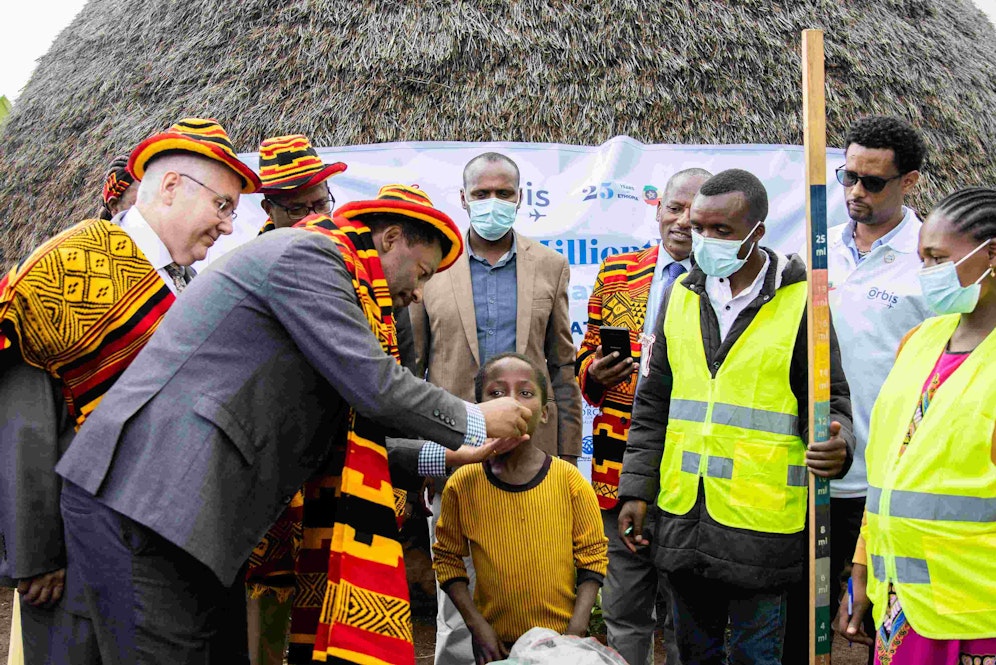
The antibiotic of choice for treating active trachoma is Azithromycin. For public health intervention in trachoma control and elimination, the dose of Azithromycin is based on measuring the height of patients. Children under the age of seven receive syrups while children above the age of seven and adults receive tablets.
The dose for children is 20 mg/kg in a single dose; adults receive a single dose of 1 g. This type of treatment is most effective in the early stages. Tetracycline eye ointment is also recommended.
The World Health Organization recommends giving antibiotics to an entire community when more than 5% of children between 5 and 9 years of age have been affected by trachoma to reduce further spreading.
In 2023, we celebrated delivering 100 million doses of the trachoma-fighting antibiotic azithromycin with the help of our partners across Ethiopia.
Orbis celebrates 100 million doses of sight-saving medication
Alongside our partners, we have delivered 100 million doses of the trachoma-fighting antibiotic azithromycin since our work began in Ethiopia.
Facial Cleanliness
Promoting education and awareness of facial cleanliness and personal hygiene such as frequently washing parts of the face with soap and clean, running water will reduce the spread of trachoma.
Environmental Improvement
Building infrastructure such as clean water points and sanitary toilets can reduce the spread of infection.

A young girl in Ethiopia visits a clean water point
How Orbis Is Tackling Trachoma and Trichiasis
Together with our wonderful partners like Sight Savers, UK Government's Department for International Development and THE END FUND we’ve already made great strides in tackling blinding trachoma.
We recently celebrated the fact that trachoma has decreased by 91% since 2002 in endemic areas. This is all thanks to the collaborative efforts of the eye health community and those who support it, helping get clean water and antibiotics to those at risk.
Orbis initiatives to tackle trachoma include:
Partnerships and Collaboration
Since 2002, we’ve teamed up with the International Trachoma Initiative (ITI), Pfizer and the Ethiopian Government, the Carter Center, Sightsavers, World Vision Ethiopia, WaterAid Ethiopia, DFID, END FUND and the BBC World Service Trust to implement the WHO’s SAFE strategy to eliminate trachoma.
44% of the world’s trachoma is found in Ethiopia where 70 million people live in areas needing mass drug administration and other interventions to address trachoma infections.
Mass Drug Administration
Since 2008 our local partnerships in Ethiopia resulted in more than 100 million doses of antibiotics to treat and prevent trachoma. Our success is testament to the strong alliances we’ve forged with hospitals and other healthcare partners.
Building a Frontline
In Ethiopia we're training nurses to perform trichiasis surgeries at primary healthcare units and building awareness of the infection by teaching community health workers, health extension workers, teachers, local women’s group leaders and community leaders about eye health. During Mass Drug Administration programs, the team recruit and train hundreds of volunteers from local communities, clinics and government-trained healthcare professionals.
While fighting trachoma is a major focus for Orbis, it is not tackled on its own. We tackle all major causes of avoidable blindness through a comprehensive approach to eye care. While we fight trachoma, we are also fighting cataract, glaucoma, diabetic retinopathy and retinopathy of prematurity at the same time.


Educating communities
A vital part of our work is educating communities and school children about eye health. In 2018, we distributed the illustrated storybook The Singing Tree in Amharic to 5,000 school eye health clubs and children in Ethiopia for free, to encourage educators, parents and children to seek help when they identify vision problems.
Dedicated eye care clubs across secondary schools in Gamo Gofa, Ethiopia, for example allow students to learn how to take good care of their eyes and what to do if their vision begins to deteriorate. The clubs also illustrate the importance of hygiene for good eye care and the prevention of trachoma.
Developing eye care in rural areas
80.5% of Ethiopia’s population live rurally and have limited access to healthcare. We’ve developed comprehensive rural eye care programs to complement trachoma outreach efforts; focusing on the elimination of trachoma using the WHO-recommended SAFE strategy. In rural areas, we've also helped set up water points so families don't need to walk miles to get to their nearest source, such as the local river where dirty water increases the risk of trachoma infection.
Eliminating trachoma
As we've learned already, trachoma is one of the leading causes of avoidable blindness worldwide, affecting millions of people in some of the world's poorest communities. But with the right investment and planning, this terrible condition can not only be treated, it can be eliminated for good.
Donate today to help Orbis and our partners rid the world of this terrible eye disease.
Donate Now
Can you help us eliminate trachoma around the world?
