English  繁體中文


  Text Size      Print


Trachoma

Trachoma is an infectious disease found predominantly in developing countries that starts as childhood conjunctivitis and progresses to corneal scarring and blindness in adulthood. ORBIS International, a non-profit humanitarian organization, teaches surgical techniques and treatment for trachoma in Ethiopia and other developing countries.

Image of children with flies on their faces

Improved sanitation could eliminate the flies
that carry trachoma.

This slowly progressive and painful disease robs its victims of their sight over the course of many years. Caused by the microorganism chlamydia trachomatis, trachoma spreads easily in overcrowded, unhygienic conditions through contact with the eye discharge or nasal mucus of an infected person often spread by flies that feed on those secretions. Technologically, blindness prevention of this type is easy to achieve, but in developing countries with limited resources, the obstacles often appear insurmountable.

A child with trachoma may rub his eyes and then touch his clothing, a towel or some other item later handled by somebody else, who then comes in contact with the organism.  A child reaching for the hand of a parent, sibling or a friend spreads the germs, or a fly may transport the germs from one infected child’s face to another’s.

Women are three times more likely than men to become infected with trachoma because they spend more time with children. Wind, dust, and smoke exacerbate the pain of trachoma, making household chores, such as cooking over an open fire or gathering wood from a dry field, excruciatingly painful. 

Image of woman with trachoma
Thichiasis has caused this woman's
eyelashes to scrape against her
cornea, blinding her right eye.
Women blinded by trachoma are often considered a burden to society. Younger women will be sent back to live with their parents so that their husbands may remarry. A daughter may be pulled out of school to take over her mother’s responsibilities, depriving the child of the opportunity to learn and make a better living. 

Although mild cases of trachoma may clear up without treatment over time, in more severe cases, years of repeated infection and eye rubbing result in trichiasis — a condition in which the eyelid becomes so scarred that it turns inward, causing the eyelashes to scrape against the eyeball, roughening and eventually clouding the cornea. If left untreated, blindness results. Blindness in Africa of this type is easily preventable in a fully industrialized country, but in developing countries the lack of resources and effective social policy pose significant challenges.

How common is trachoma?

According to the World Health Organization (WHO), approximately 84 million people are infected with trachoma, of whom about 8 million are visually impaired or irreversibly blind. Trachoma is responsible for 3.6 percent of the world’s blindness. 

Pre-school children are at highest risk of trachoma because they're prone to touching their eyes, nose and mouth and then rubbing their eyes. Parents often don’t realize the seriousness of trachoma because the blindness resulting from this disease doesn't occur until adulthood.

Although trachoma-related blindness in Africa is endemic in some remote, rural communities, especially in Ethiopia, it’s also common in parts of the Middle East and is found sporadically in southern Asia, China, parts of the Indian subcontinent, as well as parts of Latin America, Australia (among indigenous people) and the Pacific Islands.  

Prevention of trachoma

The best path for trachoma prevention is providing clean living conditions, such as building latrines, removing animal waste and ensuring a clean water supply. These actions reduce the number of bacteria, impeding the transmission of trachoma. Good hygiene and sanitation are the most powerful prevention tools available for trachoma.

Treatment of trachoma

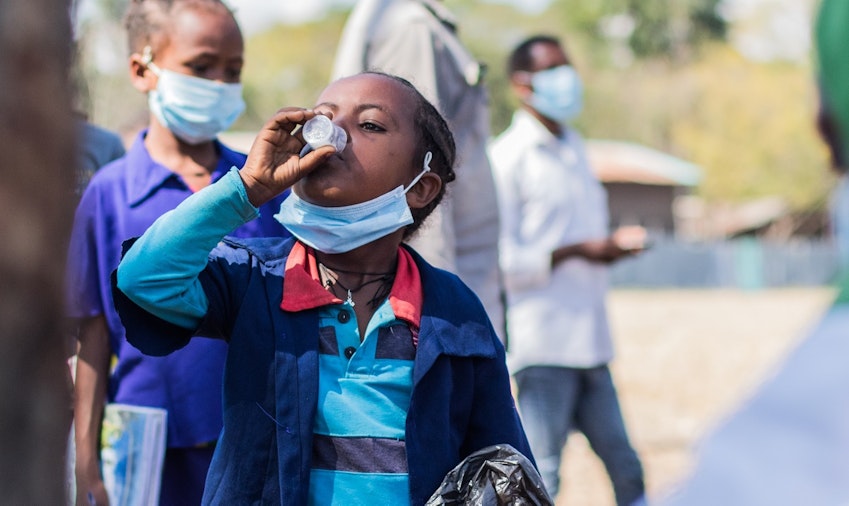
Trachoma can be treated in its early stages with regular use of antibiotic eye creams and drops. However, these can be difficult to administer to a child, and in many cases the course is not completed and the child becomes re-infected. A single oral dose of the antibiotic Zithromax can protect an individual for up to a year.

In more advanced cases, eyelid surgery can rotate the eyelashes away from the cornea, reducing pain and eliminating the scarring effect of the lashes. The procedure takes less than 15 minutes and can be performed at the village level by a trained community eye health worker.

What ORBIS is doing about trachoma

ORBIS, through its Ethiopia office, is rolling out the WHO “SAFE" strategy, which aspires to eliminate trachoma by 2020. SAFE stands for:

  • Image of woman receiving eyedrops

    Pfizer's multli-million dollar
    donation of Zithromax has
    enabled thousands to avoid the
    painful, blinding condition called
    trichiasis.

    S
    urgery to counteract trichiasis
  • Antibiotics to treat the trachoma infection
  • Facial cleanliness to avoid the spread of disease
  • Environmental changes to decrease the number of organisms

ORBIS is implementing SAFE in the following ways:

  • Training primary health care workers to perform corrective trichiasis surgery 

  • Working with the pharmaceutical company Pfizer to facilitate distribution of Zithromax, the trachoma-fighting antibiotic Pfizer has donated through the International Trachoma Initiative 

  • Training local community health workers to take on the role of administering and distributing Zithromax so that primary health care workers can concentrate on trichiasis surgery

  • Building awareness within local women’s groups that environmental improvements can reduce the risk of trachoma

  • Conducting a four-year research study in Ethiopia to assess the appropriate frequency of mass antibiotic distributions in hyper-endemic trachoma areas 

Donate Now


ORBIS is a registered 501(c)(3) nonprofit organization in the United States