Twenty-three-year-old Bunthoeuom Song, a Buddhist monk, reverted to traditional methods of healing when an insect flew into his eye, causing immense pain and corneal scarring. Subjecting his damaged eye to the smoke of medicinal incense, however, provided no relief. Instead, the sight in his eye completely disappeared. Song decided at that point to seek a more Western approach to stop the pain and regain his eyesight.
“I lived with the pain for a couple of years before I went to the eye clinic. But not having any money to pay for treatment left me in the same place I was before,” Song said. “The doctors there told me about the ORBIS organization and how they were coming to
Cambodia. He told me to come back on a particular day for pre-screening -- that maybe the ORBIS doctors could help.”
Song returns for ORBIS evaluation

When the ORBIS Flying Eye Hospital arrived in Cambodia, Song was there. Dr. Michael Vrabec, ORBIS volunteer ophthalmologist from Valley Eye Associates and assistant clinical professor at the
University of
Wisconsin, in the United States, conducted Song's preliminary examination and believed that Song’s case would have great teaching value for the local ophthalmologists at Preah Ang Duong Hospital, the host eye center, as well as the visiting ophthalmologists from
Laos and
Myanmar.
“Song represented a patient with a common scarring condition with a good prognosis for vision restoration with a cornea transplant,” said Dr. Vrabec. “His surgery was straightforward, and one that the host doctors should be able to emulate in the future.”
Corneal transplants are uncommon in
Cambodia mainly due to the scarcity of corneal donors and the lack of surgeons trained in corneal transplantation. Dr. Sok Chendra, a training ophthalmologist from Preah Ang Duong Hospital, commented that this type of procedure was very new to him and the eye health program in
Cambodia.
“Having ORBIS explain these procedures is very helpful to us all,” he said. “I want to learn as much as I can about transplant surgery and how cornea donations are managed so that we can begin performing more of these surgeries in the future.”
 |
On the night before his surgery,
Bunthoeuom Song, left, spends time with
his brother monks at their pagoda in
Phnom Penh, Cambodia. |
Song was very happy and grateful upon receiving news that he had been selected for surgery, even though he knew that the surgery might not be a complete success. His constant prayers for children, parents and the people of the world had come back to reward him, he said, and he felt honored to have the surgery.
“The first thing I want to see again is the world around me,” he said. “For years, the blindness in my eye made me sometimes feel ashamed to meet people. Now I hope and pray for no more tears. I pray for ORBIS and the people they help.”
Surgery goes smoothly
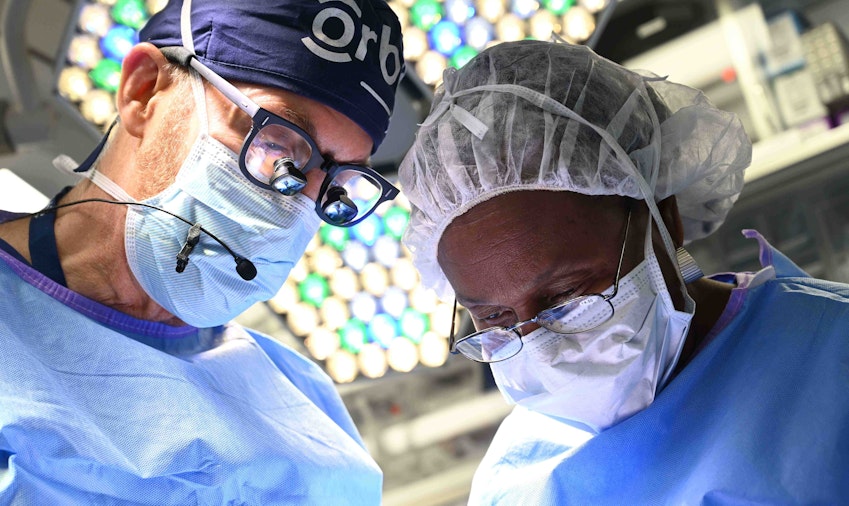
As predicted by Dr. Vrabec, Song’s surgery went smoothly and was observed by many trainees from Preah Ang Duong hospital – a gift
for Song not only from ORBIS and its volunteer medical faculty, but from the Wisconsin Lions Eye Bank and Vision Share, who donated the corneas for ORBIS’s mission to
Cambodia.
For Dr. Chendra, Song's surgery was particularly special. He had followed the case closely and was able to perform the final sutures on Song’s new cornea.
“As of this case, I have watched three cornea transplants and feel more confident about this procedure and all that is involved,” said Dr. Chendra. “I was extremely happy to be a part of this case and help with the final stages of surgery.”
Results immediate

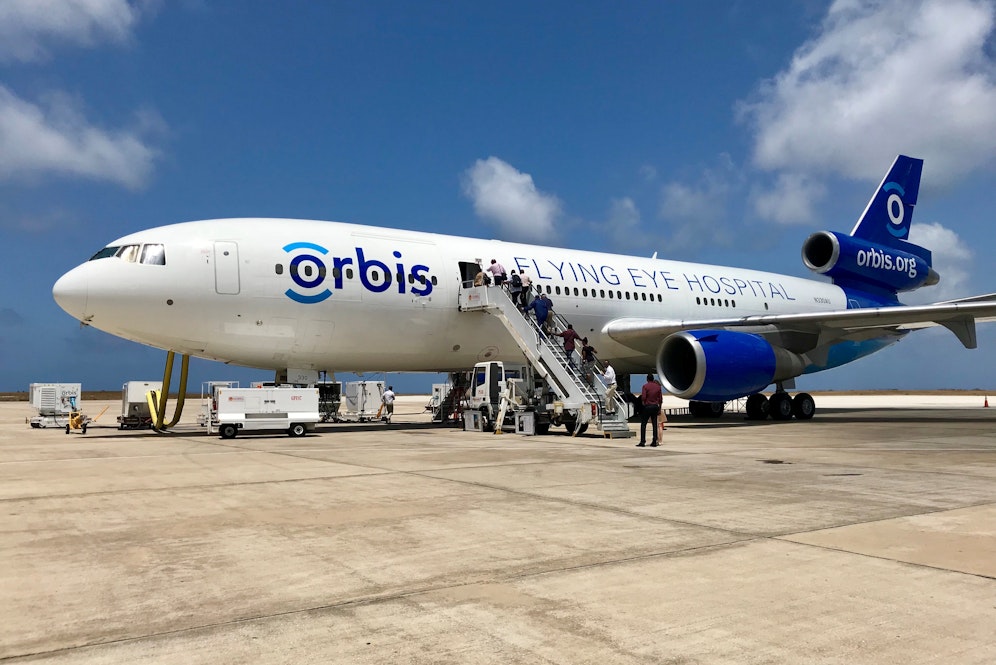
The next day, at his postoperative exam, Song looked a bit out of place in his flowing red robe aboard the colossal
Flying
Eye
Hospital and the bustling activity that surrounded him – a far cry from his humble room at the pagoda. He waited quietly in the laser treatment room as other patients moved around him, all with similar patches on their eyes, all waiting to see what, and if, they would see when the patch was removed.
Upon examination, Song’s surgery was deemed a great success. His visual acuity test showed that he could see hand motions at one meter – a huge improvement at that stage of recovery. It was then that Song shared something he had not shared before.
“I did not tell my family I was having this operation,” he said with a quiver in his voice. “I did not want to give them false hope, so I kept this to myself until after the surgery was over and I could see again. Now all I want to do is call them and see them.”
With a friend by his side, a fellow monk who had been with him from the beginning, Song stepped off the plane and descended down the stairway into a new life.
You can help
This was ORBIS's first trip to Cambodia. You can help ORBIS bring sight-saving techniques to other distant parts of the world by sharing your good fortune. Donate today and help somebody see.